
Check the details you hold
For BuildersChecked against the app on October 1, 2026
A Detail checks agent calls people to confirm that what you have on file is still right. It reads each detail back, records a yes or the correction, and finishes when the list is done. This playbook builds one for Maple Street Dental, which checks a new patient's insurance and contact details before their first visit, and runs it on a list. It starts from an organization with no agents. The choices that matter here are which details it checks, whether it takes corrections, and what it says to anyone who isn't the person.
Before you start
- You're an Owner, Admin or Builder.
- The agent needs a number to call from. If your organization has none, an Owner or Admin gets one on the agent's Caller ID step.
- Campaigns are on your plan. If they aren't, New campaign is greyed out and names the plan that has them.
- The details to check, as a spreadsheet (CSV, XLSX or XLS): one row per person, with their phone number, first name and a column for each detail.
Warning: The agent reads each detail out loud. Put on the list only what it needs to check, and nothing you wouldn't say on the phone, such as a full card number. Check what applies where you work to calling people and handling their personal details; you're responsible for your own compliance. See Your responsibilities on calls.
Steps
Create the agent
- In the menu, open Agents and click Create my first agent (New agent, once you have one).
- Under What kind of business is this?, choose Dental practice.
- Under What should it handle?, choose Detail checks. Under What should we call it?,
type
Insurance checks. - Click Create my agent. The builder opens with a card that says <name> is ready to call for Maple Street Dental.
- On the card, click See the questions. The Details step opens.
Choose the details
Choose what the agent asks has every setting.
Keep one row for each detail you hold and want checked: the insurance provider, the member ID on the card, the home address. Click X on the rest.
Click Add a detail for one that's missing, and type it under What to establish:
Dental insurance provider. A new detail starts as We already know it and Check it's right: the agent reads it back and asks whether it's still right.In each detail you hold, tick Take corrections. When the person says it's wrong, the agent records what they say instead.
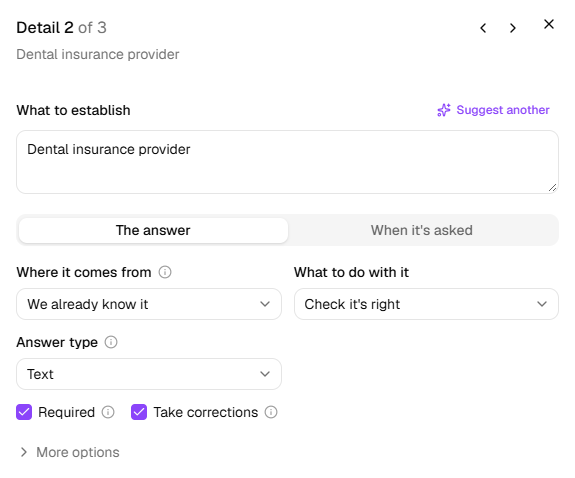
For something you don't hold yet, such as an email address you never took, choose Ask on the call under Where it comes from.
With the arrows, put the details in the order a person would go through them.
If there's no first name, click Add a detail and type
First name. The opening line uses it.
Write the opening
- Click Opening. Under Opening line, write
Hi, may I speak with {{first_name}}? This is Brian from Maple Street Dental, checking a few details before your visit.Type{{to pick the first name from the list. - Leave If someone else answers, say on Only that it's a follow-up item.
- Leave Voicemail on Leave a short message. The message says who called, never what about.
Confirm it's them before saying why is always on for a detail check: nothing on the record is said to anyone but the person it's about. Write an outbound agent's opening covers the rest of the step.
Finish the agent and go live
- Click Knowledge Base, then Add a question and answer for what people ask back:
Why are you checking?, answeredSo your first visit isn't held up by your insurance. - Open Optional, click Call Transfers, and click Add a transfer for
The person says the record is wrong and wants to speak to someone, to your front desk. - Click Calling Hours and set when people may be called.
- Click Caller ID, then Call from this beside the number people know.
- Click Try it, make up a patient in the boxes, and click Have it call me. Correct one of the details as you answer.
- Click Review & Go Live, fix anything under Is it ready?, and click Go live.
Going live calls nobody. Calls go out only when a campaign that uses the agent starts.
Run the checks
- In the menu, open Campaigns and click New campaign.
- Under Agent, choose the agent. Under Name, type
Insurance checks, week of 5 October, and click Create. The campaign opens on Add people. - Click Download this example for a file with a column for each detail the agent already knows, and make your list match it.
- Click Choose a file and pick your list. Each detail's column is Something the agent can use, under the detail's name.
- Click Add <n> rows.
- Open Launch, read Check the settings, and click Launch. Choose Start now, then click Launch.
Important: Launching calls real people, inside the calling window, a few at a time. You can pause the campaign at any point.
Import a campaign's recipients covers the file and its columns.
What happens next
On People, What happened says how each check went: verified when everything matched, verified with changes when the person corrected something. Both rows are Done.
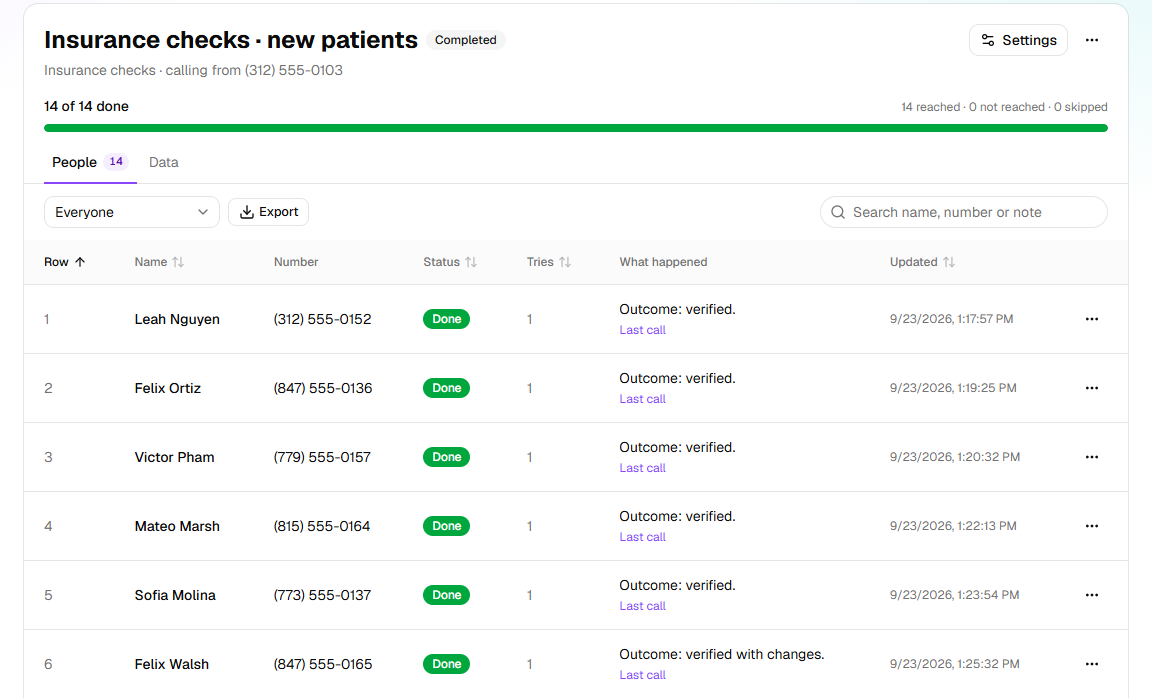
Someone who couldn't confirm (unable to verify), wouldn't take part (refused), or isn't on that number (wrong party) is Not completed, and isn't called again.
Click a row to open its call. Under Summary, Information collected shows what the call recorded, corrections included.
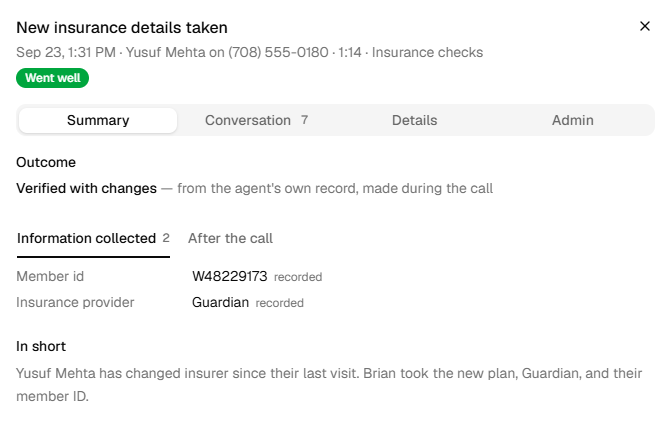
Export downloads the list as you sent it, with an Answer: column for each detail the calls recorded. Use it to bring your records up to date.
If it does not work
| You see | Why | What to do |
|---|---|---|
| There's no Take corrections box | The detail is set to Read it back to them, or to Ask on the call | Choose We already know it, then Check it's right. |
| On Review & Go Live: Add at least one detail for the agent to establish on the call. | Details is empty | Add a detail. |
| The agent also expects <detail> (<key>) — no column gives it, so it will be blank on the call. | A We already know it detail has no column | Set the column that holds it to Something the agent can use, under the detail's name. |
| <n> on the block list — added, never called. | Those numbers are on your block list | Nothing to fix: they're Skipped. |
| Not ready yet, with No recipients yet. Upload a file first. | The list is empty | On Add people, choose a file. |
| Paused: The agent is paused. | Someone paused the agent while the campaign ran | Click Resume this agent in the agent's ⋯ menu, then Resume on the campaign. |
Read next
- Choose what the agent asks — what a detail can do with what you hold
- Monitor a running campaign — statuses, and why a campaign pauses itself
- Calls, leads and contacts — where each call is kept
- Follow up on open quotes — calls that go on until a job is done